
G*Power Analysis for Two Dependent Group Measurement
We will focus on how to conduct power analysis for research aiming to test differences between pre- and post-treatment measurements.
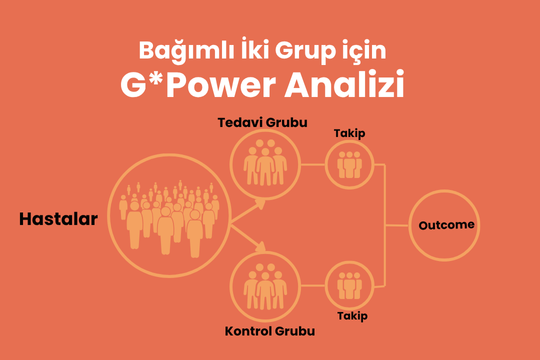
What are Dependent Samples?
Studies that evaluate differences in pre- and post-treatment measurements allow for direct observation of the effect of the applied intervention. In such research, it is crucial to include a sufficient number of participants to detect a statistically significant difference. This is where power analysis helps determine the necessary sample size, taking into account a specific effect size, significance level, and test power. In this blog post, we will focus on how to perform power analysis for research aiming to test differences between pre- and post-treatment measurements.
When there are two dependent groups, a numerical measurement is taken twice on the same group, before and after treatment, and it is investigated whether the last treatment caused a change.
To investigate the difference in pain level before and after treatment:
If parametric: Paired Sample T-Test (Mean-Standard Deviation)
If non-parametric: Wicoxon Test (Median 25%-75%)
We will consider calculating sample size to compare the means of two dependent groups.
Example: The IIEF sexual performance scale was administered to patients with prostate cancer in the urology department. The difference between IIEF scale scores before and after prostate surgery is to be examined. Was there a difference between pre- and post-operative scores?
A normality assumption check is performed. According to the Shapiro-Wilk test results, the assumption of normal distribution is met.
A correlation of over 90% is expected between the first and second measurements. This is called the design effect.
According to the dependent sample T-test result, no difference was detected. p>0.05. Based on this result, was there an insufficient sample size in our study? Let's investigate this together.