Determining Sample Size in Prevalence Studies
Prevalence refers to the frequency with which a disease or event occurs in a population. It is usually obtained from cross-sectional studies.

What is Prevalence?
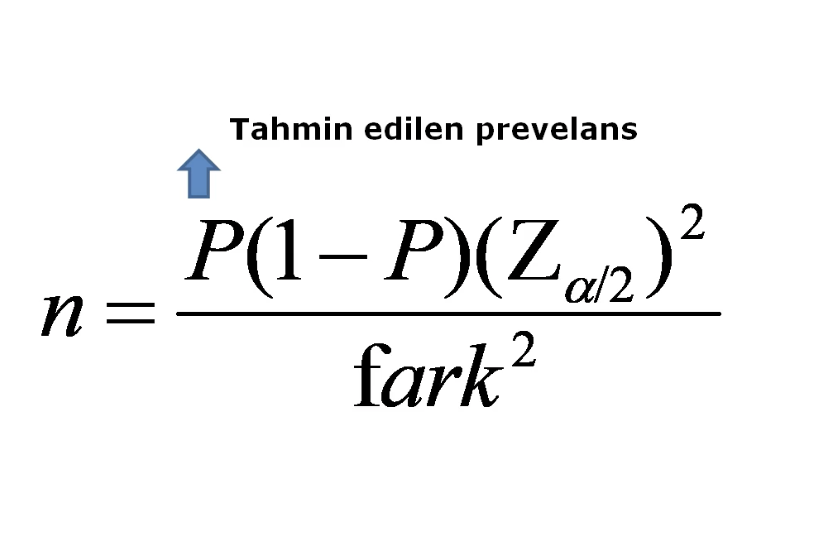
Prevalence refers to the frequency of occurrence of a disease or event in a population. It is usually obtained from cross-sectional studies and is expressed numerically as a ratio. When determining the sample size for prevalence studies, several pieces of information need to be determined.
Necessary information: Prevalence value
Accuracy value: The maximum tolerable error in estimating prevalence
Type I error value
For example, let's assume a study is being conducted on the prevalence of diabetes.
How many people should you select from that population to accurately estimate the prevalence of diabetes? The expected prevalence can be obtained from previous studies. A prevalence of 10% or 20% can be expected. When estimating prevalence, we must decide how much error we can tolerate. Finally, since we want the prevalence to be statistically significant, we need to determine the Type I error. The internationally accepted value is expressed as a 5% p-value.
Determining the sample size for prevalence studies is often confused with power analysis. The purpose of cross-sectional studies is not to make a comparison. Data obtained by screening or surveying a group are used to estimate the frequency of certain occurrences. The goal is to determine how many people should be included in the screening or survey. Therefore, this is not a Power Analysis, but rather a Sample Size Determination.